When the United States entered World War II, the 1st Infantry Division was one of the few formations with real combat experience. Its soldiers had already proven themselves in the trenches of France during World War I.
But the war they were about to fight would be very different.
No trenches.
No static front lines.
No time to learn slowly.
In November 1942, the Big Red One went back to war.
First Into the Fight, North Africa, 1942
In November 1942, the 1st Infantry Division landed on the coast of French North Africa as part of Operation Torch, the first major American ground operation against Axis forces in World War II.
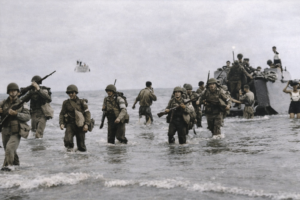
The division came ashore near Oran, Algeria, in a series of amphibious landings that tested both planning and execution. For many of the soldiers, it was their first time under combat conditions, not just facing the enemy, but dealing with the chaos of a large-scale amphibious assault: landing craft hitting the wrong beaches, confusion in the surf, and units struggling to regroup under pressure.
Initial resistance came not from German forces, but from Vichy French troops defending the coastline. In several areas, fighting broke out as American units pushed inland to secure ports, airfields, and key roads. Within days, organized resistance collapsed and Allied forces began consolidating their positions.
But the real war had not started yet.
As the campaign moved east into Tunisia, American forces, including elements of the Big Red One, began encountering German units of the Afrika Korps. These were experienced troops, hardened by years of desert warfare and led by skilled commanders who understood how to exploit weaknesses in inexperienced units.
What followed was a brutal education.
American soldiers had to quickly adapt to a new kind of warfare:
- fast-moving armored engagements
- coordinated infantry, artillery, and air attacks
- long supply lines across harsh terrain
The division that had trained for war was now learning how to survive it.
Operation Torch marked the beginning of that transformation, the moment the Big Red One entered World War II and faced a modern, highly capable enemy for the first time.
Kasserine Pass, A Hard Lesson
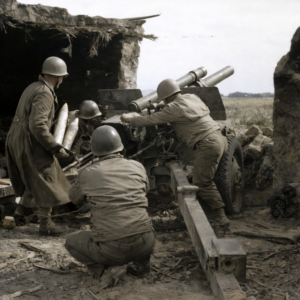
In February 1943, American forces advanced into the rugged interior of Tunisia, where narrow mountain passes and broken terrain favored the defender. It was here, at Kasserine Pass, that elements of the 1st Infantry Division and other U.S. units first faced a concentrated German counterattack.
The result was a shock.
German forces, including veteran units from the Afrika Korps, struck with speed and coordination. Using combined arms tactics, they pushed armor, infantry, and artillery forward in tightly coordinated assaults. American units, spread out and often poorly positioned, struggled to respond.
Communication broke down under pressure. Units became isolated. Defensive lines collapsed in places where they should have held. Inexperienced leadership at multiple levels made the situation worse, as orders were delayed, unclear, or simply ineffective.
German forces exploited every weakness.
American troops were pushed back through the passes, suffering heavy losses in men and equipment. For many soldiers, it was the first time they had faced a determined, highly skilled enemy, and the difference was clear.
It was one of the most serious setbacks suffered by U.S. forces in the European Theater.
But focusing only on the defeat misses the point.
Kasserine Pass was not just a failure.
It was a turning point.
In the aftermath, the U.S. Army moved quickly to correct its mistakes. Leadership was reshaped. Training was intensified. Command structures were tightened, and coordination between infantry, armor, artillery, and air support improved dramatically.
For the Big Red One and the wider American force, the lessons were immediate and practical:
- units learned to fight as part of coordinated combined-arms teams
- officers adapted to faster, more flexible battlefield decisions
- troops gained hard-earned confidence under fire
Within months, American forces returned to the fight in Tunisia with far greater effectiveness. By the time the campaign ended, they were no longer inexperienced formations reacting to German moves, they were becoming a force capable of taking the initiative.
Kasserine Pass had exposed every weakness.
What followed was the beginning of a much more capable American Army.
Sicily, Learning to Fight Together
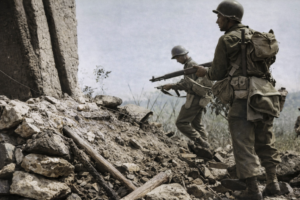
In July 1943, the 1st Infantry Division took part in the invasion of Sicily, landing along the island’s southern coast as part of the Allied push to knock Italy out of the war.
This time, the division did not arrive as an untested force.
Everything learned in North Africa was now put to the test under real pressure.
The landings themselves were contested, particularly around key objectives like airfields and coastal towns. Once ashore, the division faced a different kind of battlefield than the deserts of Tunisia:
- rugged hills and narrow roads
- fortified towns and defensive strongpoints
- determined German and Italian resistance delaying the advance
But unlike earlier campaigns, the response was different.
Coordination between infantry, artillery, and supporting units improved noticeably. Units moved with clearer lives, maintaining contact with neighboring formations and adapting more quickly when plans broke down.
Instead of confusion and collapse, there was momentum.
The division advanced inland, capturing objectives, consolidating positions, and pushing forward again. Progress was not fast or easy, it rarely is in war, but it was controlled.
That difference mattered.
Sicily showed that the U.S. Army, and the Big Red One in particular, had absorbed the lessons of North Africa. The chaotic setbacks of earlier battles were being replaced by disciplined, coordinated operations.
The fighting was still hard.
The casualties were still real.
But the outcome had changed.
The U.S. Army was no longer trying to figure out how to fight a modern war.
It was becoming effective at winning one.
Omaha Beach, The Crucible
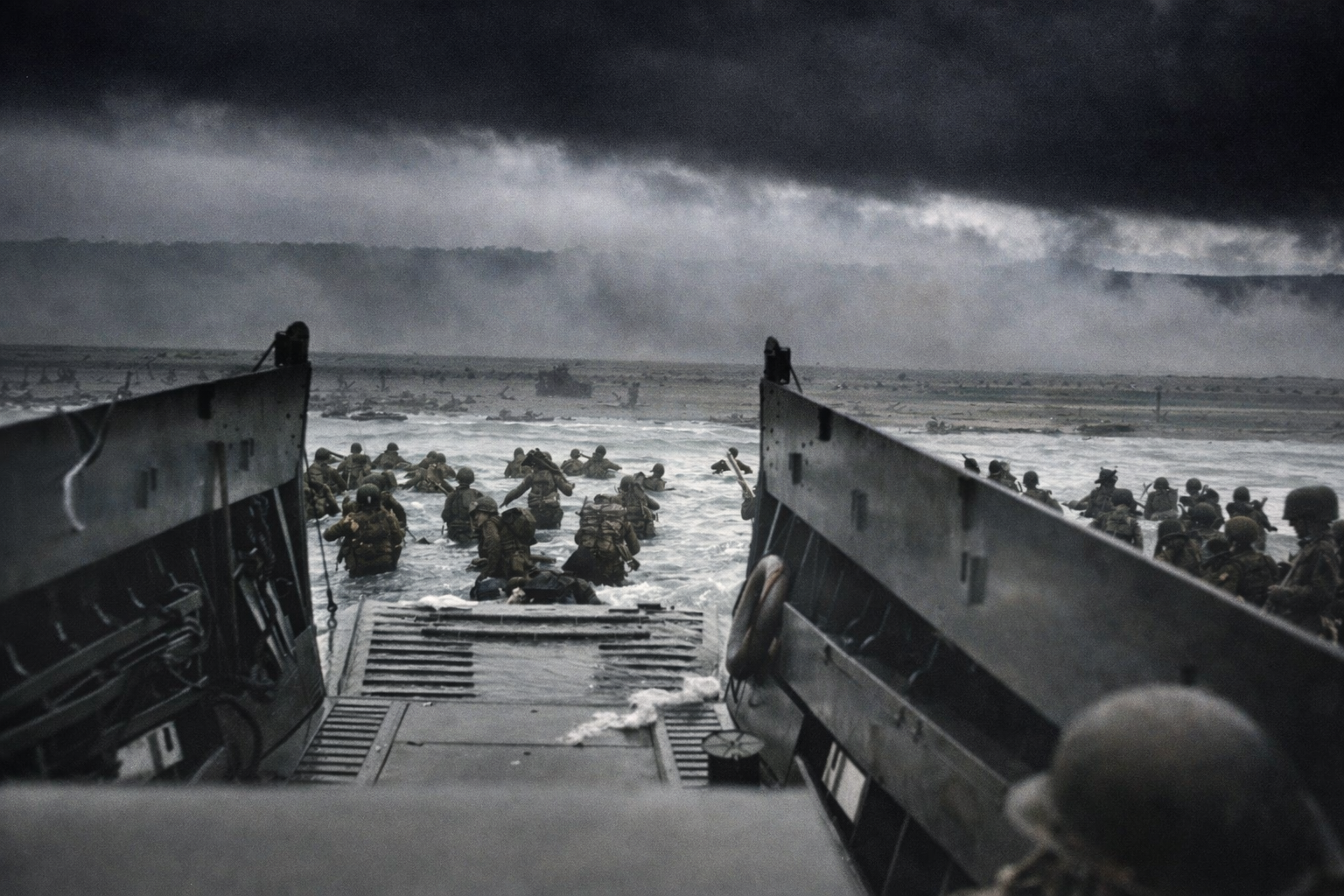
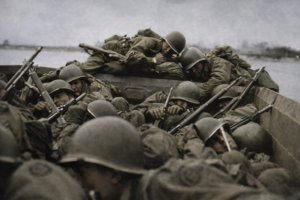
On June 6, 1944, the 1st Infantry Division landed on Omaha Beach as part of the Allied invasion of Normandy.
What they encountered was unlike anything they had faced before.
German defenses dominated the shoreline from elevated positions above the beach. Carefully prepared strongpoints covered every approach:
- interlocking machine gun fire sweeping the sand
- artillery zeroed in on landing zones
- mortars falling among troops as they came ashore
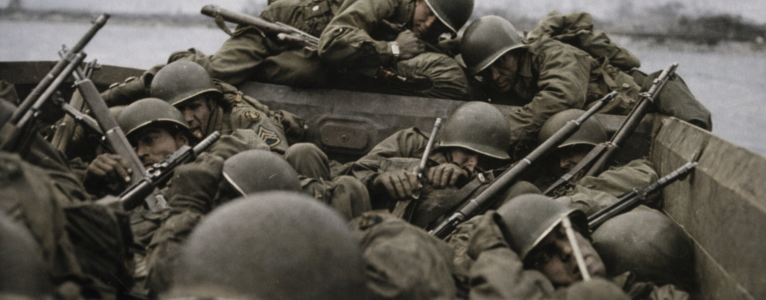
As landing craft opened, many soldiers were hit before they could even reach the water. Others waded through surf under constant fire, struggling to find cover on an exposed, open beach.
Within minutes, units were scattered.
Officers were killed or wounded. Communications broke down. Carefully planned assault waves dissolved into isolated groups of men pinned down behind obstacles, seawalls, or whatever cover they could find.
There was no coordinated advance.
There was only survival, and movement forward.
Small groups of soldiers began pushing ahead on their own initiative:
- inching across the sand under fire
- climbing the bluffs overlooking the beach
- locating and destroying German machine gun positions
- opening narrow gaps for others to follow
It was slow, brutal, and costly.
But it worked.
By the end of the day, American forces had secured a fragile foothold on Omaha Beach. The price had been high, but the breakthrough was decisive — allowing more troops and equipment to flow into France.
Omaha Beach became one of the most iconic moments in American military history.
And at the center of that fight was the Big Red One, a division that had come a long way from the deserts of North Africa, now proving itself in one of the most difficult assaults of the war.
Across Europe, The Long Advance
After Normandy, the division fought across France, Belgium, and into Germany.
The fighting did not get easier.
- hedgerow combat in France
- urban fighting in European towns
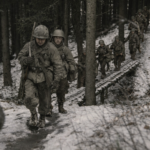
- winter warfare in brutal conditions
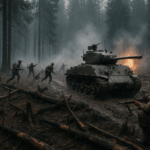
One of the most punishing campaigns came in the forests of western Germany, where visibility was limited and artillery fire shattered entire units.
Progress was slow, often measured in yards.
But the division kept moving forward.
The End of the War
By 1945, the 1st Infantry Division had fought across two continents and participated in some of the most important campaigns of the war.
From North Africa to Normandy to Germany, its soldiers had:
- learned from early defeat
- adapted to modern warfare
- fought through some of the hardest battles of the European Theater
When the war ended in Europe in May 1945, the Big Red One had secured its place as one of the most experienced and respected divisions in the U.S. Army.
A Division Forged in War
World War II transformed the Big Red One.
It entered the war inexperienced and untested against modern German forces.
It left as a veteran division that had:
- survived defeat
- led assaults
- fought across continents
- helped bring the war in Europe to an end
The division that had first proven itself in the trenches of World War I had now become something more:
A division capable of fighting anywhere, under any conditions.
And its story was far from over.
In the next part of this series, we’ll follow the Big Red One into the Cold War and beyond, where a new kind of conflict would redefine what it meant to be ready for war.
Want to step into the Big Red One’s shoes during the North Africa campaign, consider reading my book.
Books about the Italian, Normandy and German campaigns from the Big Red One’s perspective are scheduled to be released during 2026 and 2027.